

After a hiatus of 50 years the Highlands of Scotland will see the first of a new generation of pumped storage hydro projects return to our mountains, glens and lochs. While conventional hydropower has been developed in Scotland with a pedigree extending back over 100 years to the present the pumped storage variety of hydropower has been a tougher nut to crack. The original two projects, Cruachan and Foyers, were delivered by the North of Scotland Hydro-Electric Board part of the then nationalised electricity generation and supply network. The two power stations came online 10 years apart with Cruachan in 1965 and Foyers in 1975 and have now been operational for 60 and 50 years respectively.
The significant capital cost involved in building pumped storage hydro and their limited generation profile has meant that the private sector has been unable to justify such investment due to length of time involved in getting a return on investment. That is up until recently.
UK Government introduced their long awaited Long Duration Energy Storage Cap and Floor support mechanism which included pumped storage hydro in October 2024. This support mechanism is for storage technologies that can output their full capacity for more than an eight hour duration.
With the application wind opening in April 2025 this will now support a number of new industry led investments in pumped storage hydro in the Highlands and in Argyll and Bute.
PSH in the Highlands and Argyll
*hover / touch to see more information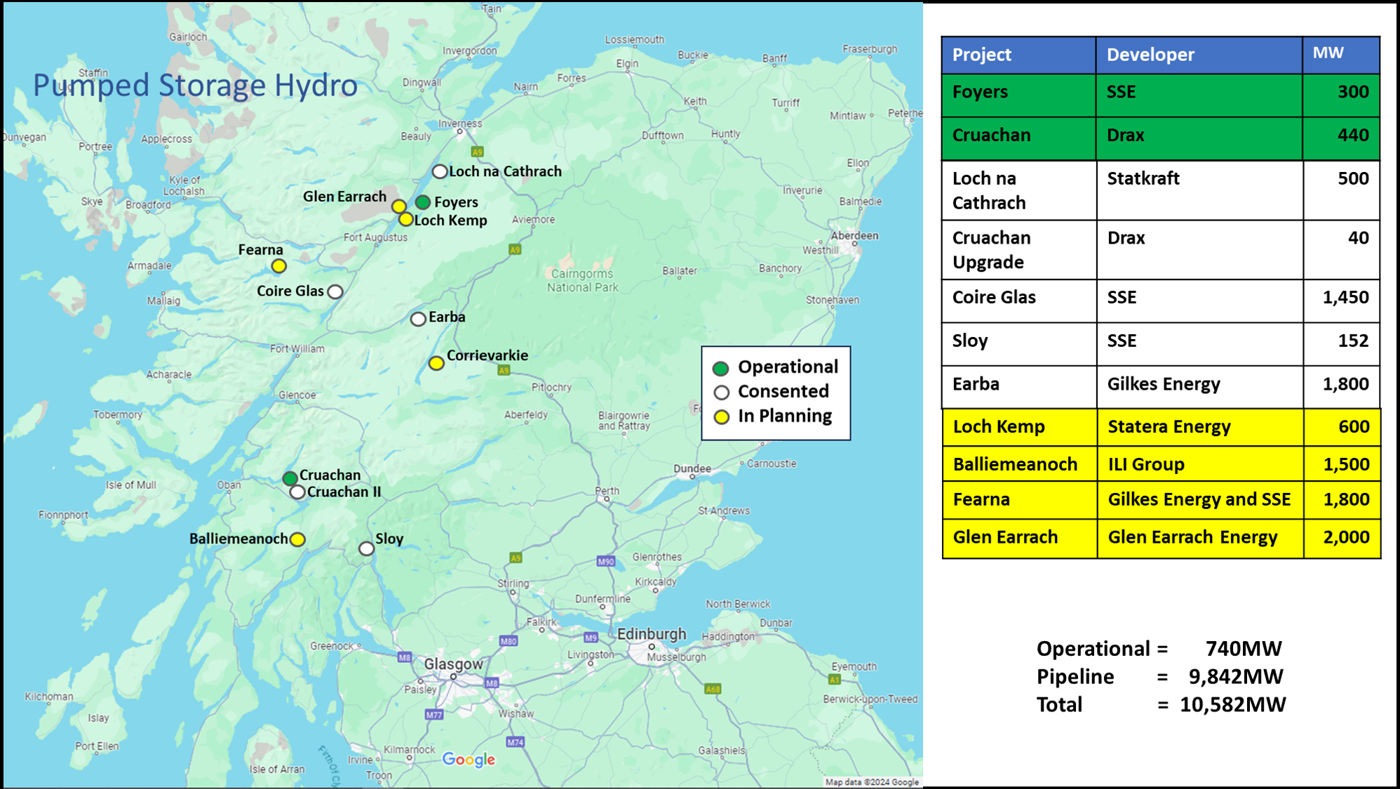
In September 2025 Ofgem confirmed the eligible projects for the first application window of the Cap and Floor scheme. Of the 77 projects they announced only 5 were pumped storage hydro. These Window 1 eligible projects included:
Track 1 (operational target date to 2030)
Loch Kemp
Loch na Cathrach
Glenmuckloch, (Dumfries and Galloway)
Track 2 (operational target date to 2033)
Coire Glas
Earba
The outcome of the Window 1 applications will be announced in August or September this year (2026).
These projects represent a huge opportunity for supply chain companies across the area and HIE will be working with all of the developers to maximise this major civil engineering investment for the local economy.
The other pipeline projects will now await the Cap and Floor Window 2 application process which is due to start after the Window 1 is completed.
The HIE area will be home to the bulk of this future Long Duration Energy Storage technology for the whole of the UK grid.